4. Marking and feedback
4.1 How do I give feedback on an IOA?
There are various approaches to delivering formative and summative feedback to students who have participated in an IOA, including in situ verbal feedback, post-IOA feedback and marking sheets. These methods are elaborated on in the tabs below. Each approach attempts to balance students’ need to receive timely and valuable feedback while also keeping the process as manageable as possible for teaching staff.
-
One approach is to provide constructive verbal feedback immediately after each student’s IOA. By allocating a dedicated time frame (e.g., five minutes) within the IOA schedule, you can promptly address any misunderstandings related to learning outcomes. This method also gives students the opportunity to seek clarification on points that may be unclear, which they tend to appreciate (see Section 3.2 for more on this). If the IOA is being used to assure student learning on a linked artefact (e.g., a written report), it is advisable to provide feedback on both components at the same time (see Section 4.2 for details).
-
Feedback can also be provided after all IOAs are complete. This might include general comments for the whole class on common strengths and areas for improvement, and/or individual feedback for each student. These comments can be shared in different formats, such as text, short audio or video clips shared via Canvas, or by offering verbal comments in class.
If the IOAs were recorded, these files can be shared with students to support self-evaluation against the feedback received. When adopting this approach, ensure that each student’s IOA is recorded and saved as individual files to maintain privacy and prevent inadvertent disclosure of other students’ information (see Section 4.5 for further details).
-
Subject coordinators can develop marking sheets featuring rubric criteria and checklists of common areas where students typically excel and those that tend to be problematic. These could be produced as physical or digital files that can be completed during or immediately after the IOA. Physical sheets could be handed directly to the student after their IOA (be sure to retain a record of the student’s mark), while digital files can be uploaded to the Gradebook in Canvas.
-
In the Public Relations and Communication case study, assessors use a comprehensive marking sheet for scenario-based IOAs that are implemented during class time. The marking sheet consists of 10 rubric criteria. For each criterion, there are tick boxes corresponding to different grade levels. At the bottom of the sheet, there's also a dedicated space for qualitative observations where assessors can note aspects outside the marking rubric. This approach enables efficient grading in situ, while also capturing nuanced feedback that goes beyond the rubric criteria. It provides a holistic view of the student's performance, balancing quantitative assessment with qualitative observations. By using a marking sheet like this, assessors can maintain consistency in grading while acknowledging the unique aspects of each student’s IOA performance.
-
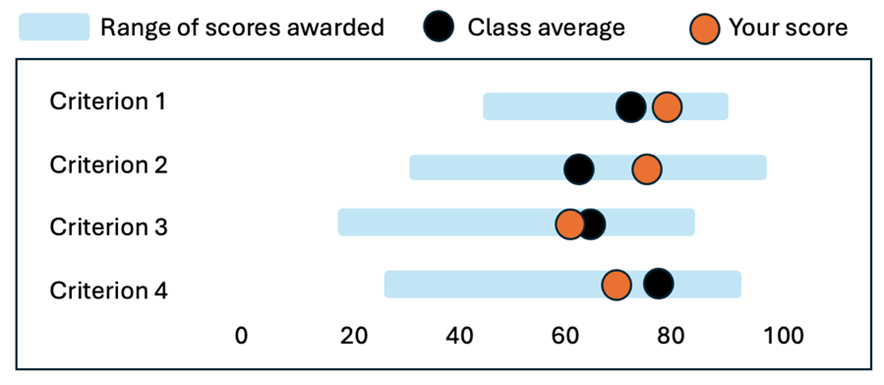
A useful alternative or complement to marking sheets is a visual summary for each rubric criterion, displaying the student’s individual performance relative to the overall range of marks awarded for that criterion across the class, and the class average score (see the figure below). It can be paired with individual feedback comments for each student to support further improvement.
Visual summary of student’s individual performance relative to the class
4.2 What if the IOA is being used to assure learning on an assessed artefact?
When an IOA is linked to a submitted artefact (such as a written essay) and is intended to assure learning in that artefact, it is important to encourage students to meaningfully engage with both parts of the assessment. Not doing so could undermine its purpose of verifying authorship and understanding in the submitted artefact. There are two approaches that may be useful here.
The first is making the linked IOA a hurdle requirement for the subject. In this scenario, if the student is unable to answer any questions during the IOA about the submitted artefact, they fail the subject. If either the IOA or the linked artefact is a hurdle requirement, it’s important to make this clear in the subject handbook and assessment instructions.
The second is assigning weightings (either separately or combined) to both the submitted artefact and the linked IOA and marking both holistically using a single rubric. If assigning separate weightings, ensure the IOA has a substantial weighting (e.g., > 10%) so that students don’t decide to deprioritise or skip this component.
In many cases, combined marks work best when provided after both components have been completed—particularly if they contribute to a single grade or when the IOA serves as a hurdle requirement linked to a prior task. One way to implement this is by creating a single Canvas Assignment within the appropriate Assignment Group, where students submit the written component and later receive their overall grade and combined feedback.
Feedback that references both components can highlight how they complement each other. Where feasible, having the same assessor mark and provide feedback for both parts can help maintain consistency and coherence in judgment.
4.3 How do I train tutors to mark IOAs?
Preparing tutors for implementing and marking IOAs often benefits from a multifaceted approach that focuses on building confidence and consistency. Formal training sessions or workshops can provide a useful foundation, introducing key differences between IOAs and traditional oral presentations, outlining implementation strategies, and offering guidance on developing effective conversational prompts. These sessions can also create space for tutors to raise questions and share uncertainties. For larger cohorts, attention to consistent use of rubrics and standardised marking approaches can help maintain fairness. Moderation meetings after IOAs may also be valuable for checking mark alignment and discussing feedback practices.
Practical activities can complement formal training. For example, mock IOAs—where tutors role-play as both students and assessors—offer hands-on experience with the rubric and provide insight into the student perspective. Reviewing exemplars, such as pre-recorded IOAs, and engaging in group calibration discussions can further support shared understanding of assessment standards.
Developing skills in impartial prompting (see Section 5.1) and constructive in situ feedback (see Section 4.1) can enhance the quality of the assessment experience for students. Tutors may also benefit from strategies for managing challenging situations, such as when students struggle to respond or when academic integrity concerns arise (see Sections 6.3 and 7.1).
Supplementary resources—such as written guides and instructional videos—can serve as helpful reference points throughout the process (for some existing resources, see Dublin City University’s Teaching Enhancement Unit page). In addition, establishing a community of practice through regular meetings can encourage ongoing dialogue among coordinators, tutors, and teaching staff, fostering the exchange of experiences and continuous improvement in IOA implementation.
4.4 How do I mark a group IOA?
For group IOAs, assessors may choose to award individual marks, group marks, or a combination of both, depending on the specific learning objectives and the nature of the task. The decision should be carefully weighed to balance the goals of equitable mark distribution and the accurate measurement of learning outcomes.
As part of a group IOA, individual students may take responsibility for explaining or answering questions about distinct aspects of the project. Depending on what is being assessed, roles could be:
- Phase-based: exploring whether students genuinely understood ‘their’ stage (e.g., rationale for the project, why a particular approach was taken, how findings were interpreted, what the team learned and would change next time); or
- Accountability-based: exploring how well students can defend a particular dimension of the work (e.g., methodological soundness, resource/time allocation, risks and unintended outcomes, and communication and impact).
It is important to ensure that this division of tasks is fair and equitable in terms of intellectual challenge. Additionally, reciprocal peer evaluation / assessment by team members can be valuable and allow for greater insight into the group dynamic and each team member’s contribution than might be apparent to an external observer. Peer assessments can also be used, and these can potentially contribute up to 10% of the final grades.
4.4 How do I manage double marking of IOAs?
According to the University’s Assessment and Results Policy (MPF1326), double marking is required for failed assessment tasks where a student has failed the subject overall. In the case of IOAs, where it is not possible for the assessment to be marked at two separate points, there are two options available:
- The first is to have two markers present for each IOA, who then agree on a single mark to be awarded. This approach requires careful planning and allocation of staff time and may need to be discussed with the head of school or department.
- The second is to record the IOA, so that the recording can be used for double marking if required. If the IOA is in-person, this can be achieved using a University-supplied video camera, or by using Zoom on a University supplied computer to record the room. If the IOA is online, set up either a Zoom or Teams meeting and use that platform to record (for more on this, see Section 4.5).
Both of these options will also support moderation processes. Note that, as with other assessment types, having an initial meeting with all assessors to go through the rubric and establish the approach to marking will support moderation and consistency (see also Section 4.3).
4.5 What do I need to know if I’m planning to record IOAs?
When recording IOAs, it’s important to explain to students that their IOA will be recorded to align with the University’s Assessment and Results Policy (MPF1326). It might also be helpful to reassure them that, if the discussion runs over the scheduled time, they will still have the opportunity to finish their responses and the recording will continue until the assessment is complete.
To efficiently manage recordings when conducting multiple individual IOAs in a single day—especially when sessions are scheduled back-to-back—consider setting up separate Zoom meetings via the Canvas Calendar for each student. This approach generates individual recordings, which simplifies remarking and supports best practices for privacy, particularly if students will be given access to their recordings for self-assessment purposes. Alternatively, starting and stopping the Zoom recording after each IOA will create separate files, noting that this option works only when recordings are saved locally to the computer rather than to the Zoom Cloud.
The University’s Assessment and Results Policy (MPF1326) requires that assessment records be kept for at least six months. When using Zoom to record, be aware that the default setting for Cloud-stored files is that they are automatically deleted after 60 days. To ensure compliance with University policy, set up Zoom so that it saves all recordings locally to the computer (in a restricted access University OneDrive folder) rather than using Zoom's Cloud storage. If using Microsoft Teams to record, the resulting files will be automatically stored in OneDrive, which has no limits on storage duration.
To help maintain privacy and manage access to recordings, it’s generally preferable to avoid using personal devices for IOAs. A practical option is to use a University-supplied computer and platform to record (e.g., Zoom, Microsoft Teams) and store recordings in a secure University OneDrive folder that is accessible only to the teaching team. This approach supports confidentiality and helps safeguard the integrity of the assessment process. Further information about student privacy in Zoom can be found here.