Our Planet, Our Health
The structure of this subject provides an opportunity for interaction between diverse student groups and guest speakers from a wide range of fields and backgrounds provide diverse intercultural perspectives.
Context
- Faculty/School: The subject is run by the Faculty of Veterinary and Agricultural Sciences and the Peter Doherty Institute for Infection and Immunity, in partnership with the Faculty of Medicine, Dentistry and Health Sciences.
- Number of students: 50-120
- Year level: Undergraduate
- Curricular/or co-curricular: Curricular
Description
Our Planet, Our Health II (UNIB20020) breadth subject provides students with the inquiry exploratory experience. Each week experts from a wide range of fields and backgrounds from inside and outside of the University are invited to talk on a particular topic which allows to incorporate diverse perspectives into the material. Students self-assign via a weekly roster to ask questions to guest lecturers.
From the start students are allocated into groups of 4-6 for their work in tutorials. Students are purposefully allocated to create a mix of different disciplines, cultural backgrounds, gender identity and previous experience including completion of the related subject Our Planet, Our Health I. The rationale for group allocation is explained to the students and it is emphasised that different perspectives can enhance our ability to address health problems for the planet. Students spend most of the time during the tutorials in their pre-allocated groups working on a discrete activity set around a case study each week. Students are encouraged to relate their personal experience and perspective to the case studies. They complete a Google Doc, Padlet page or produce a diagram as an output of their group work in each tutorial. However, there is no marked assessment related to group work allowing students to benefit from peer support without pressure of being marked based on their group performance.
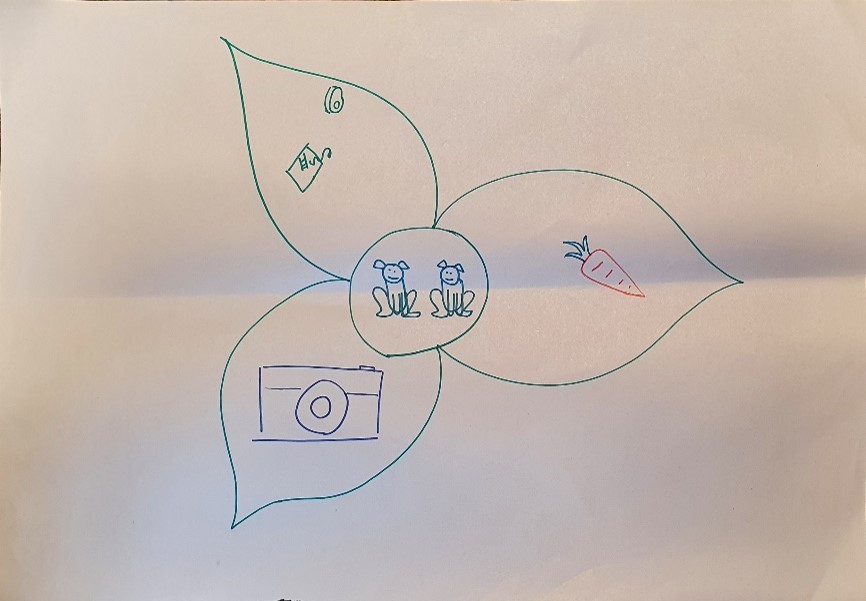
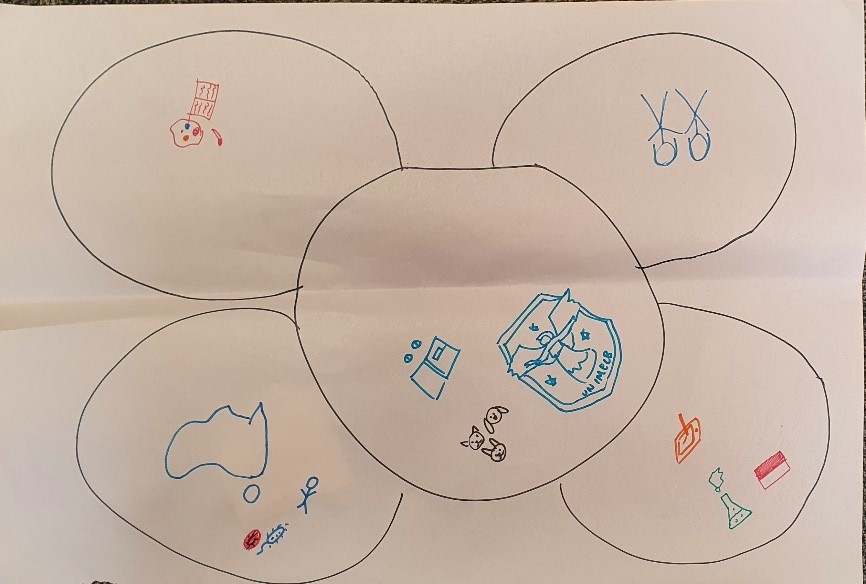
In the first tutorial, an icebreaker activity in tutorial groups of approximately 20 minutes helps create connections between diverse students. Students are asked to draw a ‘flower diagram’, drawing (not writing) something in the centre they all have in common and drawing something on an individual petal that is unique to that student within their group. Then their diagrams are shared with another group who try to interpret the drawings. This activity aims to achieve 3 things: getting all students to share, getting to know each other; getting students to use pictures to communicate rather than words, which can help communicate complex ideas; and observing that seeing someone else’s pictures without speaking to them can be easily mis-interpreted. The activity therefore highlights the importance of listening and using accessible communication styles to work across cultures and disciplines.
Some example flower diagrams (shared with student permission):
How does this program support IoC aims?
The structure of this subject provides an opportunity for interaction between diverse student groups. Guest speakers from a wide range of fields and backgrounds provide diverse intercultural perspectives, while the learning outcomes for each week clearly outline the importance of developing intercultural and interdisciplinary understanding, for example:
- Articulate the important role that local culture can play in health system resilience.
- Illustrate how different cultural contexts motivate varying approaches to addressing antimicrobial resistance.
- Illustrate how Indigenous stewardship of country has influenced Australia’s fire history, and how it could be applied to manage fire risk.
- Articulate how ‘two-way’ learning on country strengthens Indigenous and non-Indigenous health and well-being.
- Outline examples of how First Peoples balanced human and biodiversity needs in their roles as custodians of country.
- Describe with examples the advantages and challenges that arise when multiple disciplines work together to address complex problems.
What have students said about this program?
Students are overwhelmingly positive about this subject, with common themes in feedback that they enjoy the opportunity to see issues in a multidisciplinary way, to highlight perspectives they had not previously considered, and that the diversity and scope of topics covered had high relevance to real life.
Consideration for implementation
Enthusiasm for diversity and an effective multi-disciplinary approach are at the core of the staff team for this subject, and presenting these values authentically resonates strongly with the students. Continuing to learn about diversity and enriching the curriculum annually where possible helps to keep it fresh and relevant. Everyone is encouraged to bring their whole selves and their perspectives into this subject, and it starts from the staff team. Setting a strong expectation for effective collaboration and having consistent student groups throughout the semester helps create a safe environment where students can contribute their perspectives.